
Challenges Faced by Persons with Disabilities Across Arakan State
Challenges and Protection of Persons with Disabilities
Introduction
(a) Main Focus
Challenges Faced by Persons with Disabilities(b) Geographic Scope
Across Arakan State(c) Study Period
From August 2024 to October 2026.According to
According to
According to data from the 2019 Inter-censal Survey, Rakhine State alone with a population of over 3 million population accounts for
Myanmar ratified the United Nations Convention on the Rights of Persons with Disabilities (UN CRPD) in 2011. Under this convention, persons with disabilities are guaranteed full and equal enjoyment of all human rights and fundamental freedoms on an equal basis with others.
However, following the military coup, persons with disabilities in Myanmar face not only everyday social challenges but also perilous threats that endanger their basic survival. Across the country, the Myanmar military has committed severe human rights violations, including targeting and torturing persons with disabilities, arresting and imprisoning disability rights activists, and restricting or blocking necessary medical supplies and humanitarian aid. According to
This study is primarily based on reports published by local media outlets, findings from human rights organisations, statements issued by the United Nations and other international organisations, and interviews conducted by our Centre for Arakan Studies (CAS).
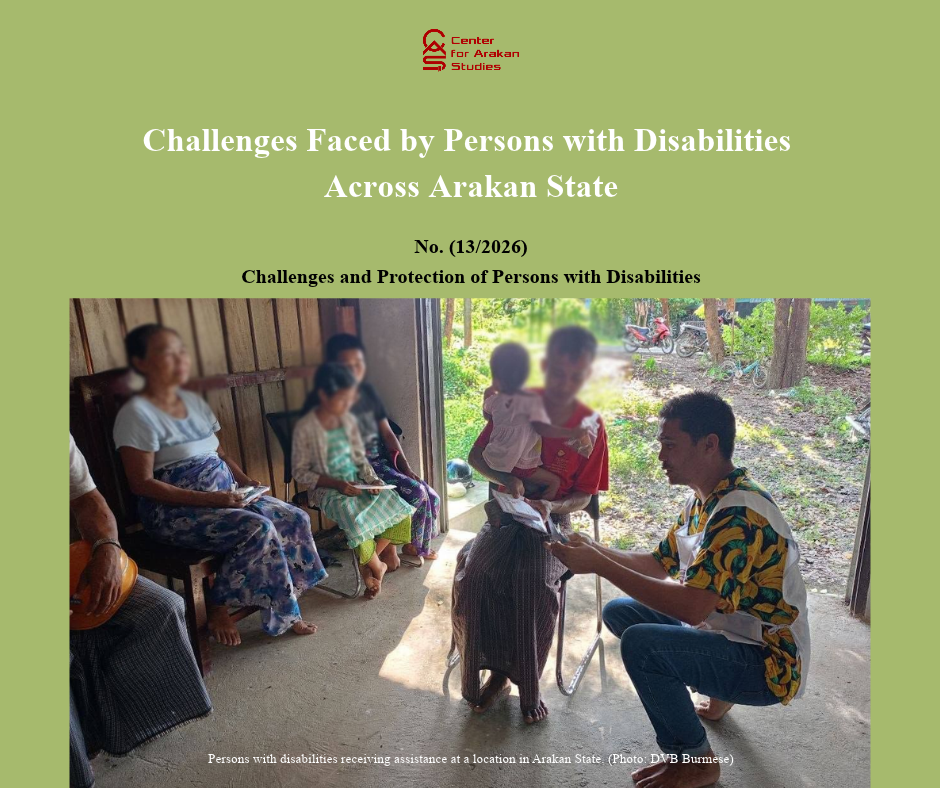
Summary of Findings
Over 500 civilians become disabled in four Arakan’s townships during conflict (Myanmar Peace Monitor-MPM)
The disabilities were caused by airstrikes, artillery and small arms fire, landmine explosions and blasts from
Ma Htwe May, General Secretary of the Rakhine State Association of Persons with Disabilities, said: “Most of the disabled people are physically disabled. There are also some with hearing and visual impairments. And there are also people who are disabled due to fire damage to their bodies.”
According to
Critical Emergency Aid Required for People with Disabilities in Arakan (Border News Agency-BNA)
In the Arakan region, civil society organisations and local residents report that people with disabilities are in need of humanitarian assistance.
As a result, people with disabilities are unable to receive protection or assistance, and they also lack essential supplies and medical aid. This has left ...

- - - - - - - - - - - - - - - - - - - - - - - - - - - - - - - - - - - - - - - - -

The CAS is an independent, non-partisan and research-oriented group conducting research and analyzing issues related to Arakan/Rakhine affairs.
October 2026 witnessed intensified military confrontations between the Myanmar junta and the Arakan Army (AA), particularly around Sittwe, Kyaukphyu, Werathani, and Ngapyi Island. Despite deploying approximately 2,000 troops and launching extensive ground, naval, and aerial offensives, the junta failed ...

Center for Arakan Studies
Following the renewed escalation of fighting in Arakan (Rakhine State) in November 2023, armed conflict expanded across many townships, while the risks posed by landmines and explosive remnants of war (ERW) became an increasingly significant challenge to civilian safety. In particular, incidents involving landmines and ERW have continued to cause civilian deaths, loss of limbs, and serious injuries in former conflict areas, around former military positions, along coastal areas, in forests and mountainous areas, ...
Center for Arakan Studies
September 2026 saw intensified fighting between the Myanmar military and the Arakan Army across Sittwe, Ponnagyun, Kyaukphyu and other fronts. The junta launched its so-called “Operation 4926,” using airstrikes, artillery, drones, naval forces and ground offensives, while the AA counterattacked and captured several junta ...
Center for Arakan Studies
Since the resumption of armed conflict in Rakhine State, restrictions on transportation, movement, and humanitarian aid have subjected the local population to severe hardships. Among the affected population, the elderly have emerged as one of the most vulnerable groups, suffering the most acute impacts. Under Myanmar's existing laws, an 'elderly person' is legally defined as an individual who has reached ...
Center for Arakan Studies
Throughout August 2026, the junta and AA engaged in intense conflict, with the regime relying on punitive airstrikes against civilians to compensate for ground losses, as acknowledged by the AA on August 6. The ULA/AA expanded governance by imposing curfews, banning underage motorcycle driving, creating a special court for rape and major crimes, ...
Center for Arakan Studies
Since the resumption of armed conflicts between the Arakan Army (AA) and the junta forces in Rakhine State, youth have borne the brunt of severe challenges and hardships. In particular, as the military junta suffered increasing losses of military personnel during the ongoing conflict, it enforced the Military Service Law and launched a campaign specifically targeting young people ...
Center for Arakan Studies
The Rohingya refugee repatriation issue represents one of the most protracted humanitarian crises along the Myanmar-Bangladesh border. This study applies complexity theory to examine four key characteristics: heterogeneity of agents, absence of problem ownership, uneven policy adoptions, and non-linearity. The crisis has evolved through multiple displacement waves since 1978, with the 2017 exodus resulting in approximately 963,000 Rohingya refugees in Bangladesh.
Center for Arakan Studies
This report examines the marginalization of once-dominant Rakhine political actors—including the ALP, ANC, ALD, RNDP, ANP, AFP, and RNP—in the shadow of the United League of Arakan/Arakan Army (ULA/AA). Using a qualitative methodology based on secondary sources, the study analyzes how these actors lost political relevance while the ULA/AA rose from a marginal force to control over 90 percent of Arakan's territory with more than 50,000 troops by mid-2026.
Center for Arakan Studies
The 2025 elections in Myanmar were conducted amid ongoing armed conflicts, territorial fragmentation, and political suppression and repression, functioning primarily as a managed authoritarian process rather than a mechanism for democratic representation. Building on historical patterns of electoral manipulation and annulment, the junta used the elections to project constitutional continuity while maintaining effective military control over political participation and outcomes.
Center for Arakan Studies
From November 2023 to December 2024, the resumption of armed clashes in Arakan, driven by the Arakan Army (AA) as part of the broader '1027 Operation,' severely disrupted border trade with Bangladesh. The conflict led to the closure of key trade routes, such as the Maungdaw-Angumaw road, halting official trade crossings and causing goods like rice and betel nuts to rot in warehouses, resulting in significant economic losses. Informal trade persisted under volatile security conditions, with local traders reporting challenges due to blockades by the Myanmar junta and ongoing fighting, which pushed both traders and authorities to seek alternative routes through India’s Mizoram via Paletwa.
Center for Arakan Studies
October 2026 witnessed intensified military confrontations between the Myanmar junta and the Arakan Army (AA), particularly around Sittwe, Kyaukphyu, Werathani, and Ngapyi Island. Despite deploying approximately 2,000 troops and launching extensive ground, naval, and aerial offensives, the junta failed to regain significant territory.
Center for Arakan Studies
September 2026 saw intensified fighting between the Myanmar military and the Arakan Army across Sittwe, Ponnagyun, Kyaukphyu and other fronts. The junta launched its so-called “Operation 4926,” using airstrikes, artillery, drones, naval forces and ground offensives, while the AA counterattacked and captured several junta outposts. Despite reported junta casualties and retreats, military operations continued, including the Kyindwe offensive launched at the end of the month.
Center for Arakan Studies
Throughout August 2026, the junta and AA engaged in intense conflict, with the regime relying on punitive airstrikes against civilians to compensate for ground losses, as acknowledged by the AA on August 6. The ULA/AA expanded governance by imposing curfews, banning underage motorcycle driving, creating a special court for rape and major crimes, introducing a 50% tax on alcohol and tobacco, and sentencing the Ponnagyun rape-murder perpetrator to death.
Center for Arakan Studies
The ULA consolidated control across Arakan State in July 2026 through banking system establishment, business licensing, and renaming Minbya and Pauktaw to historic titles on July 29. The junta responded with relentless airstrikes killing at least 12 civilians and bombing a POW camp in Maungdaw that killed four detainees, while ground clashes intensified around Kyaukphyu, Sittwe, and the Rakhine-Magway border.
Center for Arakan Studies
The AA significantly expanded control in June 2026, encircling Kyaukphyu's naval station and repelling a major junta offensive along the Rakhine-Magway border, killing 30 troops and capturing over 20 soldiers. The junta responded with intensified airstrikes and troop reinforcements while conducting mass civilian arrests in Sittwe and Ramree on suspicion of AA ties. Min Aung Hlaing visited China for official recognition and trade deals, while Bangladesh began to claim the facilitation of junta-AA talks on refugee repatriation.