
The Situation of Internally Displaced People in Rakhine State: Challenges in Security, Socioeconomic Well-being and Access to Essential Services
Internal Displacement, Vulnerabilities and Humanitarian Response
Introduction
(a) Main Focus
An assessment of the situation of Internally Displaced Persons (IDPs) in Rakhine State: Security and Civilian Protection, Access to Humanitarian Assistance, Food Security and Livelihoods, Education, and Healthcare.(b) Geographic Scope
Townships and Displacement Sites Hosting Internally Displaced Persons (IDPs) in Rakhine State(c) Study Period
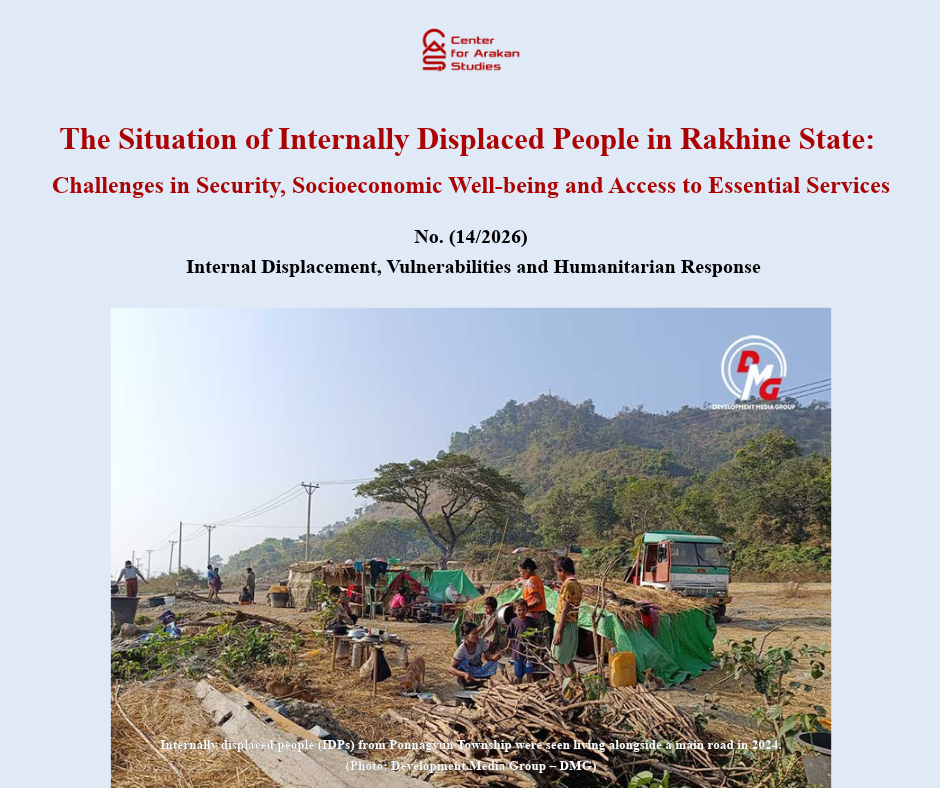
January–October 2026Throughout 2026, continued armed conflict and insecurity in Rakhine State have resulted in ongoing civilian displacement, significantly affecting the socioeconomic conditions of internally displaced persons (IDPs) and their access to essential services. Airstrikes and artillery shelling have heightened concerns over security and civilian protection, while IDPs continue to face difficulties accessing food, safe drinking water, shelter, and other necessities. Furthermore, declining livelihood opportunities and limited access to humanitarian assistance have further increased the vulnerability of displaced households.
Similarly, IDPs face significant challenges in accessing education and healthcare. These include disrupted educational opportunities for displaced children, limited capacity to afford school supplies and education-related expenses, difficulties accessing medicines and healthcare services, and increased health risks associated with flooding and infectious diseases. These conditions affect not only the immediate safety and basic needs of IDPs but also children's development and the long-term recovery prospects of displaced families.
This assessment focuses specifically on the situation of IDPs in Rakhine State during 2026, providing an overview of security and civilian protection, access to humanitarian assistance, food security and livelihoods, education, and healthcare. Drawing on reports from local media outlets and statements published by relevant humanitarian organisations, the assessment aims to identify the needs of displaced populations, the key challenges they face, and their humanitarian assistance requirements.
Summary of Findings
Military Airstrikes Force Residents to Flee Their Homes in Rakhine's Urban Areas (Western News)
Airstrikes carried out by the military council in December 2025 heightened security concerns among residents in Mrauk-U, Kyaukphyu, Thandwe, and Ngapali. Following an airstrike on Thandwe town on 31 December,
IDPs in Kyaukphyu Township Face Shortages of Drinking Water and Inadequate Healthcare Services (DMG, BNA)
According to reports published in January 2026, fighting between the military council and the Arakan Army (AA) displaced more than 30,000 to 50,000 people in Kyaukphyu Township, according to local media. Displaced people were sheltering temporarily in forests, mountainous areas, fields, monasteries, and schools. They faced shortages of

- - - - - - - - - - - - - - - - - - - - - - - - - - - - - - - - - - - - - - - - -

The CAS is an independent, non-partisan and research-oriented group conducting research and analyzing issues related to Arakan/Rakhine affairs.
October 2026 witnessed intensified military confrontations between the Myanmar junta and the Arakan Army (AA), particularly around Sittwe, Kyaukphyu, Werathani, and Ngapyi Island. Despite deploying approximately 2,000 troops and launching extensive ground, naval, and aerial offensives, the junta failed ...

Center for Arakan Studies
Following the renewed escalation of fighting in Arakan (Rakhine State) in November 2023, armed conflict expanded across many townships, while the risks posed by landmines and explosive remnants of war (ERW) became an increasingly significant challenge to civilian safety. In particular, incidents involving landmines and ERW have continued to cause civilian deaths, loss of limbs, and serious injuries in former conflict areas, around former military positions, along coastal areas, in forests and mountainous areas, ...
Center for Arakan Studies
September 2026 saw intensified fighting between the Myanmar military and the Arakan Army across Sittwe, Ponnagyun, Kyaukphyu and other fronts. The junta launched its so-called “Operation 4926,” using airstrikes, artillery, drones, naval forces and ground offensives, while the AA counterattacked and captured several junta ...
Center for Arakan Studies
Since the resumption of armed conflict in Rakhine State, restrictions on transportation, movement, and humanitarian aid have subjected the local population to severe hardships. Among the affected population, the elderly have emerged as one of the most vulnerable groups, suffering the most acute impacts. Under Myanmar's existing laws, an 'elderly person' is legally defined as an individual who has reached ...
Center for Arakan Studies
Throughout August 2026, the junta and AA engaged in intense conflict, with the regime relying on punitive airstrikes against civilians to compensate for ground losses, as acknowledged by the AA on August 6. The ULA/AA expanded governance by imposing curfews, banning underage motorcycle driving, creating a special court for rape and major crimes, ...
Center for Arakan Studies
Since the resumption of armed conflicts between the Arakan Army (AA) and the junta forces in Rakhine State, youth have borne the brunt of severe challenges and hardships. In particular, as the military junta suffered increasing losses of military personnel during the ongoing conflict, it enforced the Military Service Law and launched a campaign specifically targeting young people ...
Center for Arakan Studies
The Rohingya refugee repatriation issue represents one of the most protracted humanitarian crises along the Myanmar-Bangladesh border. This study applies complexity theory to examine four key characteristics: heterogeneity of agents, absence of problem ownership, uneven policy adoptions, and non-linearity. The crisis has evolved through multiple displacement waves since 1978, with the 2017 exodus resulting in approximately 963,000 Rohingya refugees in Bangladesh.
Center for Arakan Studies
This report examines the marginalization of once-dominant Rakhine political actors—including the ALP, ANC, ALD, RNDP, ANP, AFP, and RNP—in the shadow of the United League of Arakan/Arakan Army (ULA/AA). Using a qualitative methodology based on secondary sources, the study analyzes how these actors lost political relevance while the ULA/AA rose from a marginal force to control over 90 percent of Arakan's territory with more than 50,000 troops by mid-2026.
Center for Arakan Studies
The 2025 elections in Myanmar were conducted amid ongoing armed conflicts, territorial fragmentation, and political suppression and repression, functioning primarily as a managed authoritarian process rather than a mechanism for democratic representation. Building on historical patterns of electoral manipulation and annulment, the junta used the elections to project constitutional continuity while maintaining effective military control over political participation and outcomes.
Center for Arakan Studies
From November 2023 to December 2024, the resumption of armed clashes in Arakan, driven by the Arakan Army (AA) as part of the broader '1027 Operation,' severely disrupted border trade with Bangladesh. The conflict led to the closure of key trade routes, such as the Maungdaw-Angumaw road, halting official trade crossings and causing goods like rice and betel nuts to rot in warehouses, resulting in significant economic losses. Informal trade persisted under volatile security conditions, with local traders reporting challenges due to blockades by the Myanmar junta and ongoing fighting, which pushed both traders and authorities to seek alternative routes through India’s Mizoram via Paletwa.
Center for Arakan Studies
October 2026 witnessed intensified military confrontations between the Myanmar junta and the Arakan Army (AA), particularly around Sittwe, Kyaukphyu, Werathani, and Ngapyi Island. Despite deploying approximately 2,000 troops and launching extensive ground, naval, and aerial offensives, the junta failed to regain significant territory.
Center for Arakan Studies
September 2026 saw intensified fighting between the Myanmar military and the Arakan Army across Sittwe, Ponnagyun, Kyaukphyu and other fronts. The junta launched its so-called “Operation 4926,” using airstrikes, artillery, drones, naval forces and ground offensives, while the AA counterattacked and captured several junta outposts. Despite reported junta casualties and retreats, military operations continued, including the Kyindwe offensive launched at the end of the month.
Center for Arakan Studies
Throughout August 2026, the junta and AA engaged in intense conflict, with the regime relying on punitive airstrikes against civilians to compensate for ground losses, as acknowledged by the AA on August 6. The ULA/AA expanded governance by imposing curfews, banning underage motorcycle driving, creating a special court for rape and major crimes, introducing a 50% tax on alcohol and tobacco, and sentencing the Ponnagyun rape-murder perpetrator to death.
Center for Arakan Studies
The ULA consolidated control across Arakan State in July 2026 through banking system establishment, business licensing, and renaming Minbya and Pauktaw to historic titles on July 29. The junta responded with relentless airstrikes killing at least 12 civilians and bombing a POW camp in Maungdaw that killed four detainees, while ground clashes intensified around Kyaukphyu, Sittwe, and the Rakhine-Magway border.
Center for Arakan Studies
The AA significantly expanded control in June 2026, encircling Kyaukphyu's naval station and repelling a major junta offensive along the Rakhine-Magway border, killing 30 troops and capturing over 20 soldiers. The junta responded with intensified airstrikes and troop reinforcements while conducting mass civilian arrests in Sittwe and Ramree on suspicion of AA ties. Min Aung Hlaing visited China for official recognition and trade deals, while Bangladesh began to claim the facilitation of junta-AA talks on refugee repatriation.